
What is Rock Wool and Why It Matters in Hydroponics
Rock wool, also known as stone wool or mineral wool, is one of the most widely used substrate materials in modern hydroponic farming. Manufactured from melted rock fibers spun into a wool-like texture, rock wool provides exceptional water retention, superior aeration, and a sterile growing environment that eliminates soil-borne pathogens. In commercial hydroponic operations, rock wool cubes and slabs serve as the primary growing medium for high-value crops including tomatoes, cucumbers, peppers, strawberries, and leafy greens. The material's uniform structure allows growers to achieve consistent moisture distribution across entire crop zones, directly translating into predictable yields and harvest quality. This article examines the technical properties of rock wool, proper preparation procedures, crop-specific application methods, and operational best practices for commercial hydroponic facilities.
Technical Properties of Hydroponic Rock Wool
Rock wool for hydroponic use is manufactured to precise specifications that distinguish it from insulation-grade materials. The density of horticultural rock wool typically ranges from 60 to 80 kg/m3, with fiber diameters between 4 and 6 microns. This combination creates a pore structure that retains 80 to 90 percent air by volume when fully saturated, while simultaneously holding 15 to 20 percent moisture in the fiber matrix. The pH of new rock wool cubes initially ranges from 7.0 to 8.0, which requires buffering with acidic nutrient solution before use. Electrical conductivity (EC) of unused rock wool is negligible, allowing growers to establish precise nutrient regimes from the first irrigation cycle. The thermal insulation properties of rock wool also protect root systems from temperature fluctuations in greenhouse environments, maintaining more stable root zone temperatures compared to bare nutrient solution systems.
Rock Wool Preparation: Buffering and Conditioning
New rock wool cubes and slabs must be properly conditioned before planting to ensure optimal crop performance. The preparation process begins with soaking the rock wool in an acidic solution with a pH of 4.5 to 5.0 for 24 hours. This acid soaking leaches excess calcium and magnesium ions from the fiber matrix while simultaneously lowering the substrate pH to a range of 5.5 to 6.5, which is ideal for most hydroponic crops. After acid soaking, the rock wool is drained and allowed to reach container capacity by soaking in a complete nutrient solution matching the target crop's fertigation formula.
Commercial operations typically precondition rock wool slabs by running drip irrigation lines for 48 to 72 hours before transplanting. Growers should monitor the runoff EC and pH during this period to confirm stable nutrient equilibrium. The capillary action within rock wool fibers distributes moisture evenly throughout the slab, eliminating dry zones that could cause uneven crop development. Properly conditioned rock wool should feel heavy when lifted, indicating full saturation, but not drip excessively when squeezed, which would indicate free gravitational water displacing air in the pore space.
Crop-Specific Application Methods
Rock wool cubes in sizes ranging from 2.5 cm to 10 cm are used for seed germination and seedling propagation in hydroponic nurseries. The small format of propagation cubes allows for precise moisture control critical during the vulnerable germination stage. Seeds are placed in pre-drilled holes in the cube tops, and moisture is maintained through misting systems or shallow nutrient film irrigation. Seedlings typically develop transplantable root systems within 10 to 21 days depending on crop species and greenhouse temperature regimes.
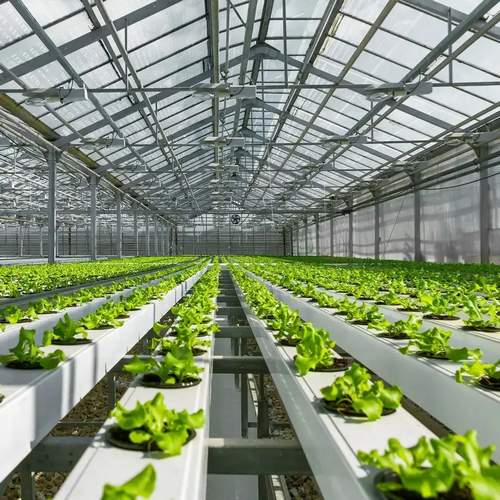
For fruiting vegetables such as tomatoes and cucumbers, rock wool slabs measuring 100 cm by 30 cm by 7.5 cm provide the optimal root zone volume for plants grown to full production. Slabs are positioned on growing benches or floor channels with individual drip stakes delivering nutrient solution to each plant station. The slab dimensions create a uniform root zone that simplifies irrigation scheduling across entire greenhouse bays. Growers typically maintain 3 to 5 drip stakes per slab, adjusting flow rates based on plant developmental stage and ambient greenhouse temperatures.
Irrigation Management in Rock Wool Systems
Effective irrigation scheduling in rock wool-based hydroponic systems requires balancing plant water uptake with substrate moisture reserves. The irrigation frequency depends on crop type, plant developmental stage, greenhouse climate conditions, and the specific rock wool product characteristics. Young seedlings require light and frequent irrigations that keep the root zone adequately moist without waterlogging. As plants transition to generative growth phases, irrigation cycles lengthen and the volume per event increases to encourage deeper root development into the rock wool matrix.
Modern commercial greenhouses utilize load cell weighing systems or substrate moisture sensors integrated with climate computers to trigger irrigation events automatically. These systems calculate daily water consumption based on the difference between slab weight at container capacity and current weight, triggering irrigation when the weight loss reaches a preset threshold. For tomato crops grown in rock wool during summer production in heated greenhouses, irrigation events may occur every 20 to 30 minutes during peak solar radiation periods, while winter production may see only 3 to 5 irrigation cycles per day.
Disposal and Environmental Considerations
Rock wool slabs have a typical productive lifespan of 1 to 3 years depending on the crop grown and the sanitization protocols employed between crops. At end of use, rock wool presents both challenges and opportunities for environmental management. The material is not biodegradable in conventional landfill conditions, but it can be recycled into construction aggregate or used as a soil amendment in landscaping applications. Some manufacturers now offer biodegradable rock wool alternatives made from organic fibers for container nursery applications, though these materials have not yet achieved widespread adoption in commercial hydroponic production due to concerns about structural integrity and pathogen harbor.
Progressive hydroponic operations are exploring circular economy approaches including steam sterilization and reuse protocols that extend slab life beyond the traditional single-crop cycle. Steam treatment at 90 degrees Celsius for 30 minutes effectively sanitizes rock wool without degrading fiber structure, allowing second and third crop cycles when combined with rigorous pathogen monitoring. These practices reduce both material costs and the environmental footprint of hydroponic food production systems.
Conclusion
Rock wool remains the substrate of choice for commercial hydroponic operations seeking precise control over root zone environments and consistent crop production outcomes. The material's superior physical properties, including high porosity, uniform water distribution, and sterile initial conditions, enable growers to achieve predictable results across diverse crop portfolios. Successful rock wool utilization requires attention to proper conditioning procedures, crop-specific irrigation management, and ongoing monitoring of substrate parameters throughout the production cycle. As hydroponic technology continues to advance, rock wool cultivation systems will likely incorporate increasingly sophisticated sensor networks and data-driven management protocols that further optimize resource efficiency and yield quality.
